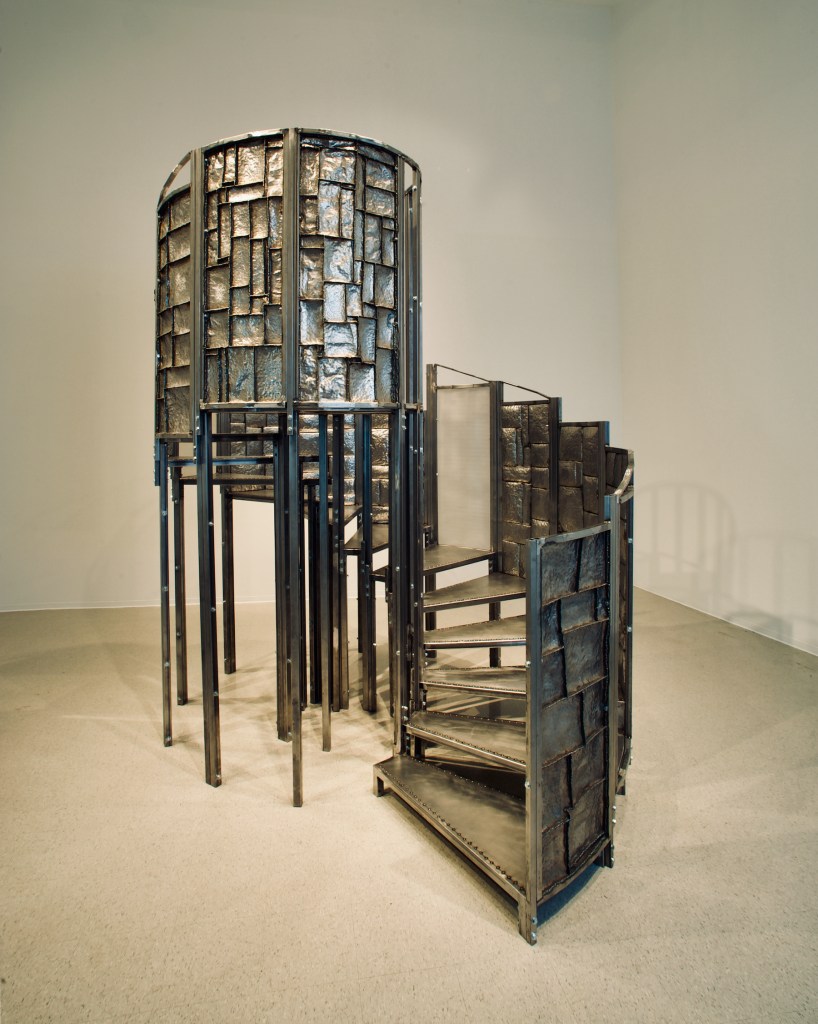
El Caracol
14th Shanghai Biennale: Cosmos Cinema
Power Station of Art
November 8, 2023 – March 31, 2024
El Caracol(2022) engages with the ancient Maya practice of observing the cosmos as a way of understanding time beyond the limits of a single human life. In its reimagination of Indigenous knowledges, cosmologies, and ritual practices, the work expresses the artist’s conviction that “gifts of generosity and messages of wisdom filled with intergenerational knowledge can circulate through spacetime and reach others.”
Its spiralling structure is inspired by an observatory built by the Maya at Chichen Itza. In Cortez’s homage to that ancient, abstract architectural form, a thirteen-step staircase leads to a platform from which visitors can contemplate the cosmos. The building, the name of which translates as “the snail,” was constructed according to Mayan astronomical charts and is believed to have served as the setting for cosmic ceremonies. In keeping with the original, the observatory functions as a symbolic portal from which to view and imagine other worlds.
The 14th Shanghai Biennale was curated by Anton Vidokle, Zairong Xiang, Hallie Ayres, Lukas Brasiskis, and Ben Eastham.
Photo courtesy of the artist and Commonwealth and Council, Los Angeles and Mexico City.

Shifting Center
EMPAC, Troy, NY
Hudson River Preview October 28-29, 2023
Exhibition opens November 3, 2023
Shifting Center stages the process of listening to infrasonic landscapes, acoustic architectures, and unsounded instruments across scales of time. The exhibition will comprise sculptural, moving-image, and spatial-audio installations presented throughout the concert hall, proscenium stage, and studios at EMPAC.
A “shifting center” is a technical term from the field of acoustics that describes the perceived dislocation in the position of a sound source. Supported by the Teiger Foundation, and building on research funded by the Andy Warhol Foundation, the exhibition considers two opposing tendencies: dislocation—how objects, artworks, and cultural belongings are taken from their original context and silenced through the mechanisms of museological preservation and display—and location—how architecture and acoustics impact exhibitions as resonant spaces of situated listening.
With contributions from Tania Candiani, Padmini Chettur and Maarten Visser, Beatriz Cortez, Guillermo Escalón and Igor de Gandarias, Cannupa Hanska Luger, Maurice Louca, and Clarissa Tossin, among others, Shifting Center will utilize theatrical infrastructure and spatial audio technologies, such as higher-order ambisonics and wave field synthesis, and propose techniques and practices to locate and listen to contemporary artworks that are themselves locating and listening to past events, instruments, architectures, and landscapes. EMPAC’s building was designed to focus on tuning architectural acoustics and it was listened to throughout the building process. How can these spaces also tune-in to the systemic dislocation on which they are built?
If the colonial museum interrupts the time of the object, then the artworks in the exhibition follow the dislocation to foreground circulation through movement, temporality, and recursion. All three aspects are present in Beatriz Cortez’s monumental sculpture, Ilopango, The Volcano that Left. Imperceptible frequencies sounded before the Terra Blanca Joven volcanic eruption of circa 536 CE blasted magma that traveled thousands of miles into the stratosphere reflecting light from the sun away from the earth to produce a multi-year winter that plagued the ancient Maya civilization reaching Europe, Asia, and Antarctica. Cortez describes “the volcano that left” as an act of migration and considers what it would mean for it to return.
Escalón accompanies de Gandarias’ experiments translating infrasounds from the seismic activity of the Fuego volcano of Guatemala into an orchestral work that resists its place in the canon of western classical music. Candiani activates Hole-in-the-Rock, a geological formation that resembles a loudspeaker. Chettur and Visser position the axes of a dancing body in the mandala-like geometry of an amphitheater at the archaeological site of Nagarjunakonda, South India, displaced and relocated by the building of a hydroelectric dam. Tossin entwines the voice of K’iche’ poet Rosa Chávez with the sound of Alethia Lozano Birrueta playing 3D replicas of ancient Maya flutes that are held in museum collections. The microtonal composition of Louca’s ensemble searches for missing vowels through the imagination of animal vocalizations, magical texts, and demotic songs. And the screeching frequencies of Luger’s Aztek whistles sound the transition between the living and the dead.
Shifting Center is choreographed not just in space but also in time. The unique technical capacities of EMPAC support an exhibition format and its sonic and experiential potential. By tuning each work in relation to each other, the exhibition will reach across disciplinary boundaries to simultaneously inhabit their attendant temporalities, such as the evental nature of performance and the durational scale of an exhibition. While Cortez’s sculpture draws our attention to the still continuing geological and ecological effects of a past eruption, de Gandarias’ composition reminds us that the volcano performs for us every day as an instrument of the earth.
Shifting Center will extend through a partnership with Storm King Art Center and the Vera List Center for Art and Politics at The New School to support Cortez’s sculpture, which will sail up the Hudson River from the artist’s solo exhibition at Storm King to EMPAC just prior to the exhibition opening of Shifting Center. Escalón will document the river journey for a future film.
Shifting Center is curated by Vic Brooks and Nida Ghouse.
 BEATRIZ CORTEZ